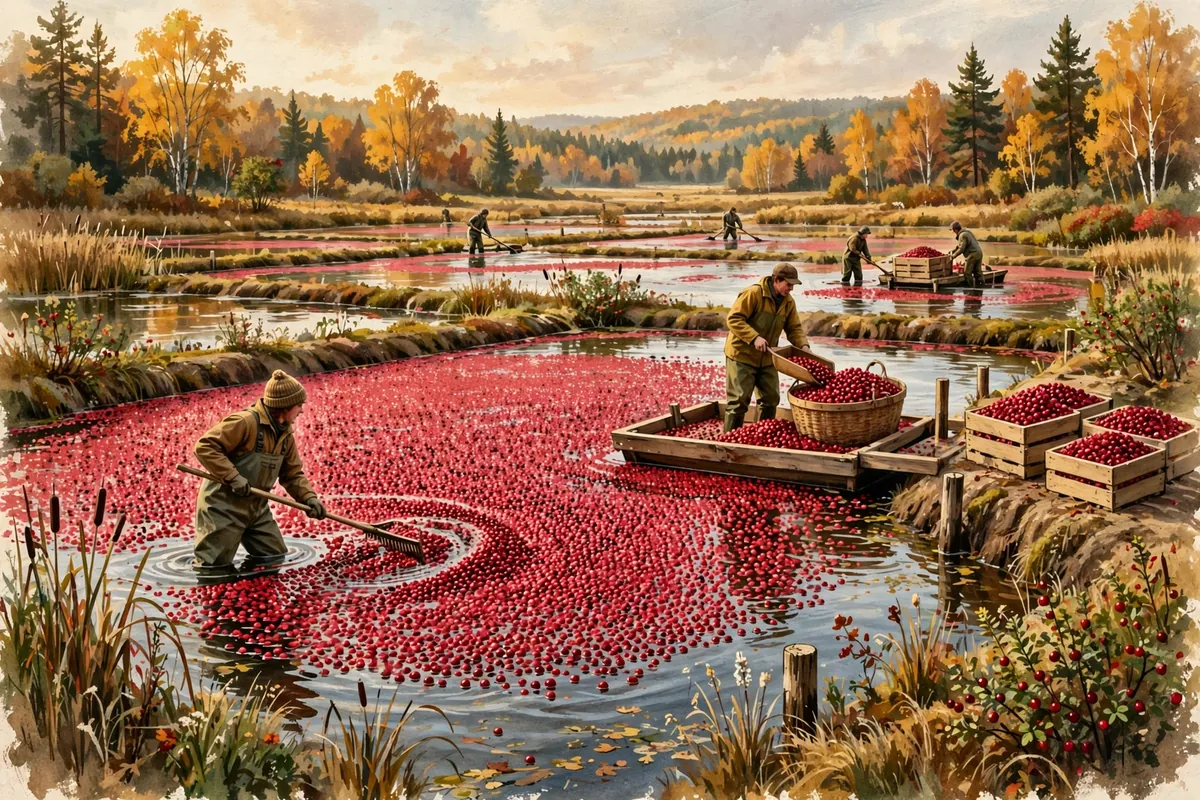
Every fall, photos pop up of farm fields turned into shimmering pools of red. Workers in waders stand among millions of bobbing cranberries. It's a beautiful sight, and it's easy to assume cranberries grow in water like rice.
They don't. Cranberries grow on low, creeping vines in sandy beds. The flooding only happens at harvest time, and it works for one simple reason: cranberries float. Cut one open and you'll find little pockets of air inside, which make the berry lighter than the water around it. Farmers take advantage of that to gather huge crops quickly.
How a Wet Harvest Works
Cranberries are harvested in the fall, when the fruit turns its deep red, ideally after the first frost. That's usually from September into early November.
The beds themselves are built for the job. Historically, they were made in wetlands. Today, growers usually build them on higher ground with a shallow water table. They scrape off the topsoil to form dikes around the edges, spread a layer of clean sand, and level the surface with lasers so it drains evenly. Those dikes are what let a bed hold water when it's time to flood it.
To harvest, farmers flood the beds with about 6 to 8 inches of water above the vines. Then a harvester is driven through the beds to knock the fruit loose. Since the 1960s, machines called water reel harvesters have done this job.
Once free, the berries float to the surface. Workers corral them into a corner of the flooded bed, and from there the berries are conveyed or pumped out. They're then taken to receiving stations to be cleaned, sorted, and stored.
Not Every Berry Gets Wet
Most cranberries are wet-picked, but about 5 to 10 percent of the U.S. crop is still dry-picked. It costs more and yields less. The upside is that dry-picked berries get fewer bruises, so they can be sold fresh instead of being frozen or processed right away.
Dry picking was once done with two-handed comb scoops. Today, small motorized harvesters that you walk behind do the work, gently enough to avoid damaging the vines.
Here's another fun twist. Cranberries can be harvested early, while they're still white. That's how white cranberry juice is made, though yields are lower when berries are picked that soon.
A Truly American Fruit
Cranberries have deep roots in North America. The Narragansett people of New England appear to have used them in food and for dye, and they may have introduced the berries to colonists in Massachusetts. In 1643, Roger Williams called them bearberries, because bears ate them.
The name cranberry has a more poetic origin. It traces back to an old German word meaning crane berry. Colonists thought the plant's flower, stem, and petals looked like the neck, head, and bill of a crane.
Farming them took off in the 1800s. Around 1816, Revolutionary War veteran Henry Hall began cultivating cranberries in the Cape Cod town of Dennis, Massachusetts. By the 1820s, he was shipping them to New York and Boston.
From Bog to Table
In 2021, the United States harvested about 790 million pounds of cranberries. Wisconsin was the top producer by far, growing about 59 percent of the total, followed by Massachusetts, New Jersey, and Oregon.
So the next time you spoon cranberry sauce onto your holiday plate, think about those floating red fields. That tart little berry earned its way to your table by doing something surprisingly simple: staying afloat.