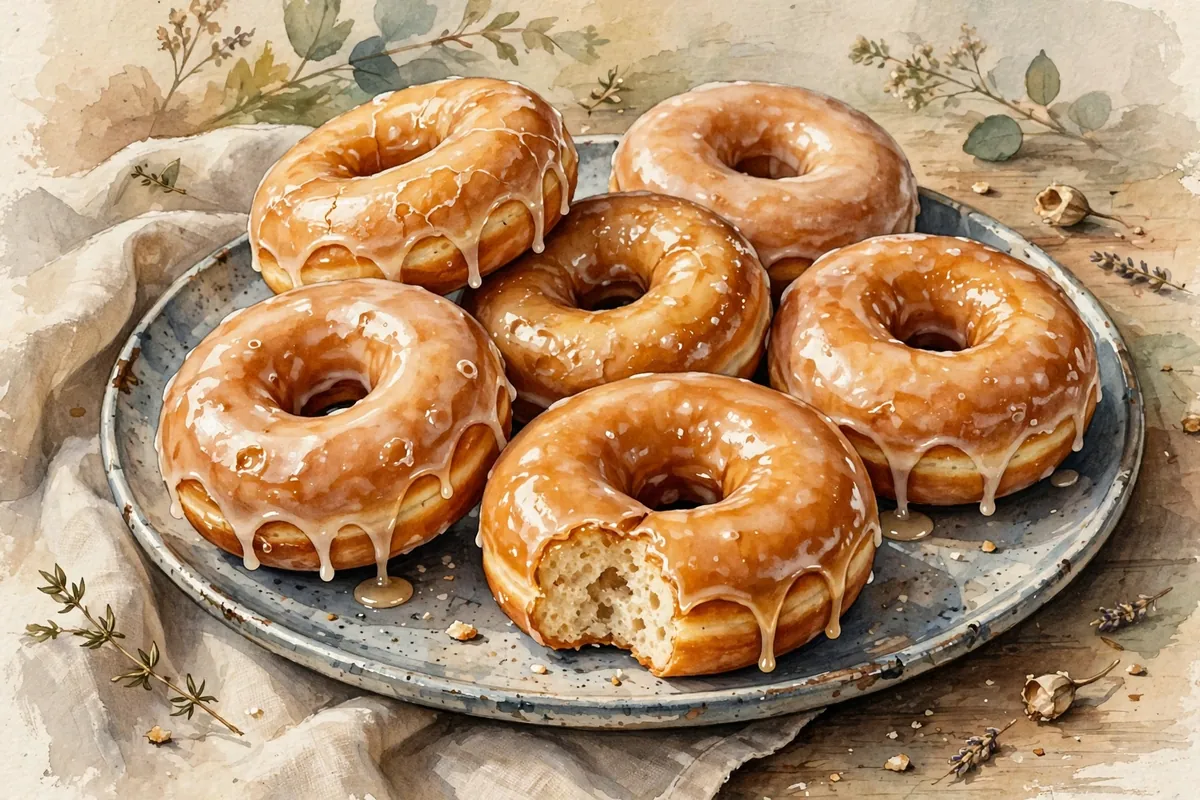
Take a bite of a glazed doughnut and you probably don't give the hole a second thought. It's just how doughnuts look. But for a long time, doughnuts didn't have holes at all, which raises a fun question: who decided to take the middle out?
The most famous answer comes from Hanson Gregory, an American who claimed he invented the ring-shaped doughnut in 1847, when he was a 16-year-old sailor on a ship trading limes. He said he punched a hole in the dough with the ship's tin pepper box. Food historians, though, say the true origin of the hole is still up for debate.
Before the Hole: Balls of Fried Dough
People have been frying dough for a very long time. The Roman writer Cato the Elder recorded a recipe for fried dough balls made with cheese, honey and poppy seeds. A 13th-century Arabic cookbook even describes shaping dough into a ring with a hole in the middle, though that was to test the dough before frying the first batch. The Spanish and Portuguese churro was served in a ring shape, too.
In America, Dutch settlers brought olykoeks, meaning oil cakes, to New York in the early 1700s. They looked a lot like later doughnuts, but without the hole. Over in England, a recipe for fried dough nuts was published in 1750. In 1809, writer Washington Irving described dough-nuts as balls of sweetened dough fried in hog's fat. Today we'd probably call those doughnut holes.
The Sailor and the Pepper Box
According to Gregory's story, he was tired of greasy, twisted doughnuts and of the raw, doughy centers of round ones. So he used the ship's pepper box to cut out the middle, and later taught the trick to his mother.
Smithsonian Magazine has described his mother, Elizabeth Gregory, as making a wicked deep-fried dough flavored with nutmeg, cinnamon and lemon rind. She reportedly put hazelnuts or walnuts in the center, where the dough might not cook through. She called the treats doughnuts, though the word itself had already appeared in print decades earlier, in an 1808 short story.
Other Theories About the Hole
Not everyone is convinced Gregory deserves the credit. Food writer Michael Krondl thinks the ring shape may have come from recipes that called for dough to be shaped like a jumble, a ring-shaped cookie that was once common.
Culinary historian Linda Civitello offers a more practical explanation. The hole helps doughnuts cook faster and more evenly, solving that raw-center problem. Whoever came up with it first, the idea caught on. By 1870, doughnut cutters made of two circles, one inside the other, were showing up in home-shopping catalogs.
How the Hole Became a Treat
A doughnut cutter slices out the ring and the center in one push. That leftover circle of dough can be added back to the batch or fried on its own as a doughnut hole. Not every ring needs a cutter. Some bakers stretch a disk of dough until the center breaks open, and others use a machine called a depositor that drops a circle of batter straight into the fryer.
In a funny twist, those little bites bring doughnuts full circle, right back to the solid fried balls that Washington Irving wrote about more than 200 years ago. Grab one with your coffee and you're tasting a bit of history.