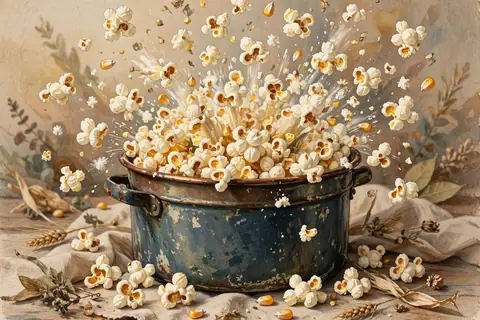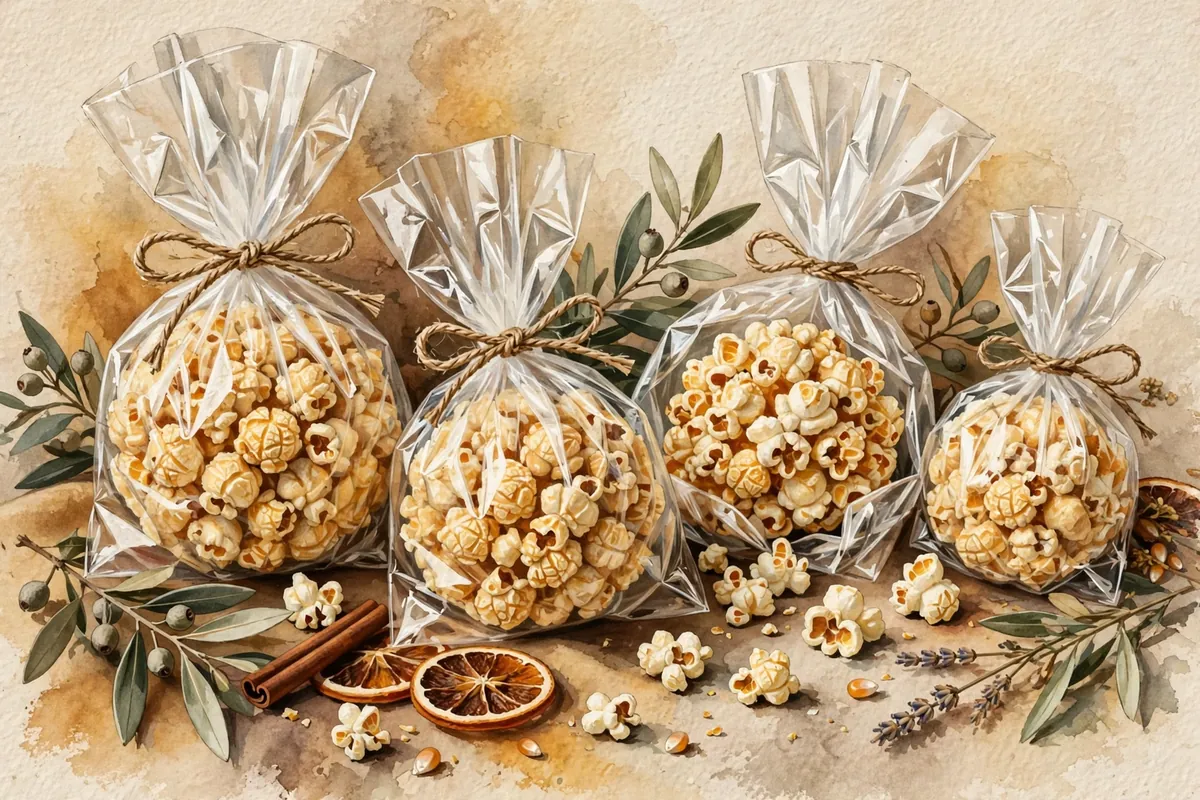
Ask an older relative about Halloween as a kid, and there's a good chance popcorn balls will come up. Sticky, sweet, a little messy, and wrapped in cellophane, they were a fall favorite in many neighborhoods. Today they're rarer, but some families still make them every October.
Popcorn balls, popped kernels stuck together with a sugary glue, were hugely popular around the turn of the 20th century. Their popularity has faded since then, but they're still served in some places as a traditional Halloween treat. There's no single documented reason they became tied to Halloween. They were cheap, easy to make at home in big batches, and already a favorite snack when modern Halloween customs were taking shape.
America's Popcorn Craze
Popcorn has long been an American favorite. Through the 1800s, people popped kernels by hand on stovetops, and the term popped corn appeared in an 1848 dictionary of Americanisms. In 1885, Charles Cretors of Chicago invented a popcorn machine, and he introduced it at the 1893 Columbian Exposition.
At that same fair, F.W. Rueckheim introduced a molasses-coated candied popcorn, the first caramel corn. His brother tweaked the recipe and introduced it as Cracker Jack in 1896. Sweet popcorn treats were officially a hit.
By the turn of the century, Cretors had street carts with steam-powered poppers. During the Great Depression, a bag of popcorn cost just 5 to 10 cents, and popcorn thrived while many other businesses failed. It became a source of income for struggling farmers, including the Redenbacher family, whose name lives on in Orville Redenbacher's popcorn. During World War II, sugar rationing cut candy production, and Americans ate three times as much popcorn as before.
When Trick-or-Treat Took Off
Trick-or-treating as we know it is younger than you might think. The phrase seems to have started in central Canada. The earliest known example, "tricks or treats," comes from a 1917 newspaper in Sault Ste. Marie, Ontario. It spread across the northern and western United States in the 1930s and the rest of the country through the 1940s and early 1950s.
In that era, a homemade popcorn ball was an inexpensive way to give a whole crowd of costumed kids something sweet.
The Fear of Homemade Treats
Over the years, many parents grew wary of unwrapped or homemade treats. In much of Canada, giving apples at Halloween has been taboo since the 1960s, when stories, almost certainly of questionable authenticity, spread about razors hidden in them.
Folklorists, scholars, and law enforcement experts say the idea that strangers poison trick-or-treaters' candy has been thoroughly debunked. Confirmed cases of poisoned candy are rare, and no cases of strangers killing children this way have been proven. Experts note that the biggest real danger to kids on Halloween is traffic.
Why Popcorn Pops
Making popcorn balls starts with a little kitchen physics. Each kernel holds moisture inside a tough hull. When heated, that water turns to steam, and pressure builds to about 135 pounds per square inch. At around 356 degrees Fahrenheit, the hull bursts, and the starchy insides puff up to 20 to 50 times their original size.
So if you're feeling nostalgic this Halloween, try making a batch. Bundle them in cellophane, add a bit of orange ribbon, and enjoy a treat that has been bringing sticky smiles for over a century.