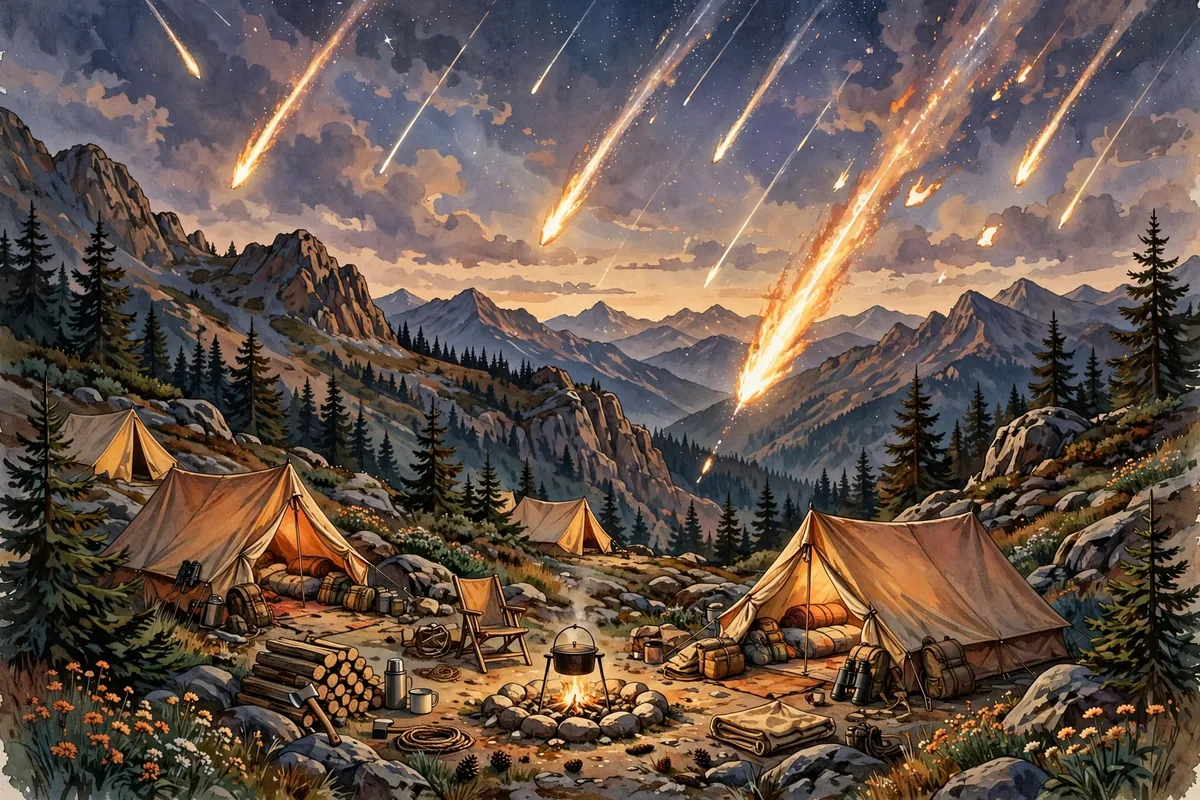
Shooting stars usually feel like a lucky accident. You happen to look up at the right second, and a bright streak flashes across the sky. But a few times a year, you can almost set your calendar by them. Meteor showers like the Perseids in August arrive on roughly the same nights, year after year.
Here's the short answer: meteor showers happen when Earth passes through a trail of dust and debris left behind by a comet, or occasionally an asteroid. Those trails stay in roughly the same place along Earth's path around the Sun. So every time our planet reaches that spot in its orbit, around the same date each year, we plow through the debris again and get a shower.
Comets Leave a Trail of Crumbs
Astronomer Fred Whipple famously described comets as "dirty snowballs," made of rock embedded in ice. Each time a comet swings close to the Sun, some of that ice turns to vapor, and the escaping gas drags along bits of dust, sand, and pebbles.
Over many trips around the Sun, those particles spread out along the comet's entire orbit, forming a long stream of debris. When Earth crosses that stream, the particles hit our atmosphere at high speed and burn up as meteors. Some meteoroids slam into the air at up to about 71 kilometers per second, or roughly 159,000 miles per hour.
Sometimes a comet even falls apart. Biela's Comet was seen split in two in 1846. When Earth crossed its orbit in 1872, a strong meteor shower lit up the sky, helping confirm the link between comets and meteors.
The Perseids: Summer's Most Reliable Show
In most years, the Perseids are the most dependable meteor shower, peaking around August 12 at more than one meteor per minute under good conditions. They come from Comet Swift–Tuttle, which takes about 133 years to orbit the Sun.
Most of the particles in the Perseid stream have been drifting along that path for around a thousand years. Near Earth, the cloud is huge, stretching roughly 0.8 astronomical units along our orbit. One astronomical unit is the average distance from Earth to the Sun, about 93 million miles.
Why They Seem to Come From One Spot
If you watch a shower for a while, the meteors all seem to fly out from one point in the sky, called the radiant. That's a trick of perspective. The particles are actually traveling on parallel paths, just like railroad tracks that seem to meet at the horizon.
Showers are usually named for the constellation where the radiant sits. The Perseids appear to come from the direction of Perseus, and the Leonids seem to pour out of Leo.
When a Shower Becomes a Storm
Some years, Earth hits an especially thick patch of debris, and a shower turns into a meteor storm, with at least 1,000 meteors an hour. The Leonids are famous for this, roughly every 33 years when their parent comet, Tempel–Tuttle, returns. After the great Leonid storm of 1833, astronomer Denison Olmsted showed that the meteors had arrived as a cloud of dust from space.
One astronomer has even calculated that Earth could pass through an extra-dense part of the Perseid stream on the night of August 11 to 12, 2028, possibly producing a storm. So grab a lawn chair and mark your calendar. The comet crumbs will be right on time.