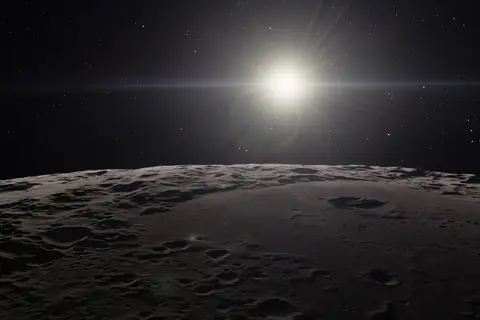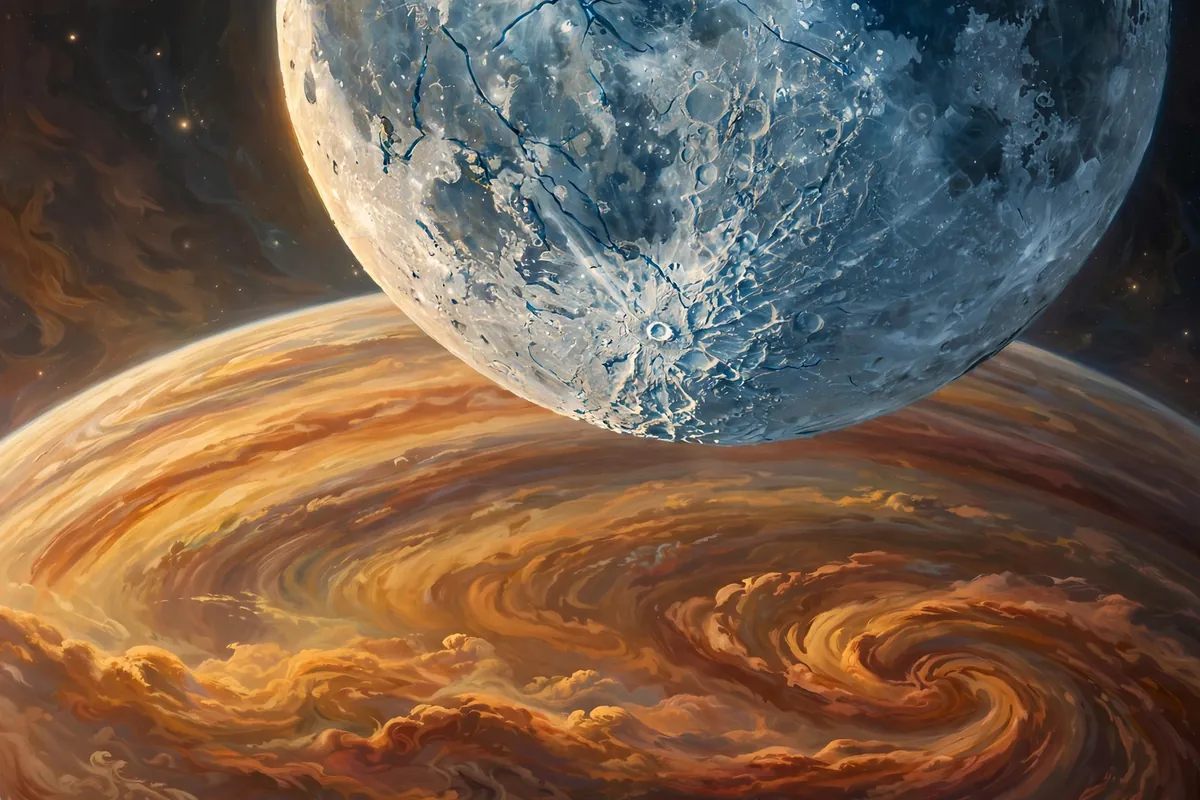
Jupiter has dozens of moons, but one keeps scientists up at night. Europa is a little smaller than our own Moon and covered in a bright shell of ice laced with tan cracks and streaks. Its surface averages about 260 degrees below zero Fahrenheit at the equator. It hardly sounds like a place with water you could swim in.
Yet the scientific consensus is that Europa has a layer of liquid water hidden beneath that ice. Europa's outer layer of water is estimated to be around 62 miles thick, part of it frozen into a crust and part of it a salty ocean underneath. Because liquid water is one of the key ingredients for life as we know it, Europa is one of the most exciting places to search beyond Earth.
How Do We Know It's There?
Nobody has drilled through Europa's ice, so the evidence is indirect, but it's strong. The biggest clue came from NASA's Galileo spacecraft, which orbited Jupiter from 1995 to 2003.
Galileo found that Europa has a weak magnetic field that's induced by Jupiter's own powerful field. For that to happen, Europa needs a layer of material inside it that conducts electricity very well. The most likely candidate is a large ocean of salty liquid water.
The surface backs this up. Europa is the smoothest known solid object in the solar system, with no big mountains or craters. Its young, smooth surface and its huge network of crisscrossing cracks point to an ocean below, and some features may even be coated with sea salt brought up from underneath.
What Keeps It From Freezing?
Europa is far from the Sun, so sunlight can't keep that water liquid. The heat comes from Jupiter itself. Europa's orbit is slightly oval, so it moves a little closer to Jupiter and then a little farther away.
As it gets closer, Jupiter's gravity stretches the moon. As it moves away, the moon relaxes back into a rounder shape. All that squeezing and stretching, called tidal flexing, kneads Europa's insides and generates heat, a bit like a paperclip warming up when you bend it back and forth. Scientists think that's enough to keep the ocean from freezing solid. The energy ultimately comes from Jupiter's own spin, passed along through a gravitational tug-of-war among Jupiter's biggest moons.
Plumes Shooting Into Space?
The Hubble Space Telescope has spotted what look like plumes of water vapor rising from Europa, similar to the icy geysers seen on Saturn's moon Enceladus. In 2018, scientists found more support for plume activity in older Galileo data.
If those plumes are real, they could be a huge shortcut. A spacecraft might be able to sample material from the ocean simply by flying through a plume, without ever landing.
Going to Take a Closer Look
No spacecraft has landed on Europa yet. NASA's Europa Clipper launched on October 14, 2024, and is on a roughly five-and-a-half-year trip to Jupiter. Rather than orbit Europa, it will orbit Jupiter and swoop past the moon again and again to study whether it could support life. Europe's Juice mission, launched in 2023, will also make two flybys of Europa.
Whatever the probes find, it's a thrilling thought. Right now, on a frozen moon hundreds of millions of miles away, there may be an ocean sloshing quietly in the dark.