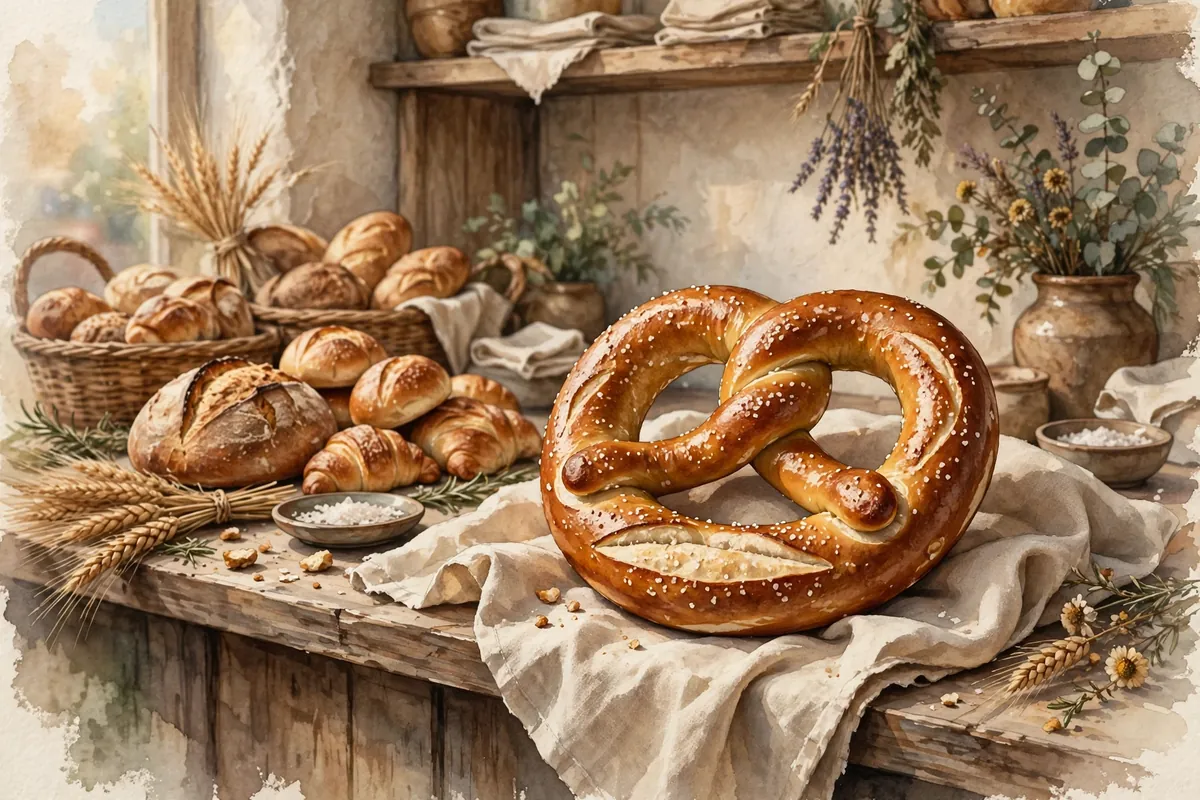
Most snacks come in simple shapes: squares, circles, sticks. Then there's the pretzel, with its knot of dough looping back on itself. It's such a strange shape for a bread that you have to wonder who thought of it, and why.
Here's the short answer: nobody knows for sure. There are many stories about where pretzels came from, and most give them a Christian background and credit European monks. The most popular tale says an Italian monk created them in the year 610, twisting strips of dough to resemble two arms crossed in prayer. It's a charming story, but it's a legend rather than documented fact.
The Monk and His Little Rewards
In the best-known version, the monk wanted a special treat to motivate his students to keep learning. He rolled out strips of dough, crossed them to look like hands praying, and baked them. Then he handed them out, calling them pretiola, or little rewards.
Other versions place the invention in a monastery in southern France. In Germany, one story even claims pretzels were invented by desperate bakers being held hostage by local nobles.
The name may hint at the arm idea, too. The German word Brezel may come from Latin words meaning bracelet or little arm.
What History Can Confirm
The firm evidence starts later. Pretzels have served as an emblem of bakers, and of their guilds, in southern German areas since at least the 12th century. A 12th-century illustration from the Alsace region, now part of France, may contain the earliest known picture of a pretzel.
Pretzels also had religious meaning in the church. Made with a simple recipe of flour and water, they could be eaten during Lent, when Christians were forbidden to eat eggs, lard, or dairy. Over time, pretzels became tied to both Lent and Easter. People even hid pretzels on Easter morning, much the way eggs are hidden today.
Pretzel Traditions
Some charming customs survive in Europe. In Luxembourg, the fourth Sunday of Lent is known as Pretzel Sunday. Boys give their sweethearts pretzels, and the size is said to show how much he likes her. If a girl wants to return the interest, she gives him a decorated egg at Easter. In leap years, the custom is reversed.
In parts of Bavaria, lye pretzels are served alongside a main dish such as Weisswurst sausage. Swabian pretzels have very thin arms and a fat belly, while Bavarian ones keep their arms thicker.
How Pretzels Came to America
Pretzels arrived in North America in the late 1700s with southern German and Swiss German immigrants, who became known as the Pennsylvania Dutch. Southeastern Pennsylvania is considered the birthplace of the American pretzel industry, and the state still makes about 80 percent of the nation's pretzels.
The crunchy hard pretzel is an American creation. In 1850, the Sturgis bakery in Lititz, Pennsylvania, became the first commercial hard pretzel bakery. In 1949, a machine called the pretzel bender could twist 50 pretzels a minute, more than twice as fast as skilled hand twisters. Thicker sticks, about half an inch across, are sold in the U.S. as pretzel rods.
So whether the shape really started as praying arms or not, the pretzel has had quite a journey from monastery legend to everyday snack. Next time you grab one, take a second to admire that famous twist.