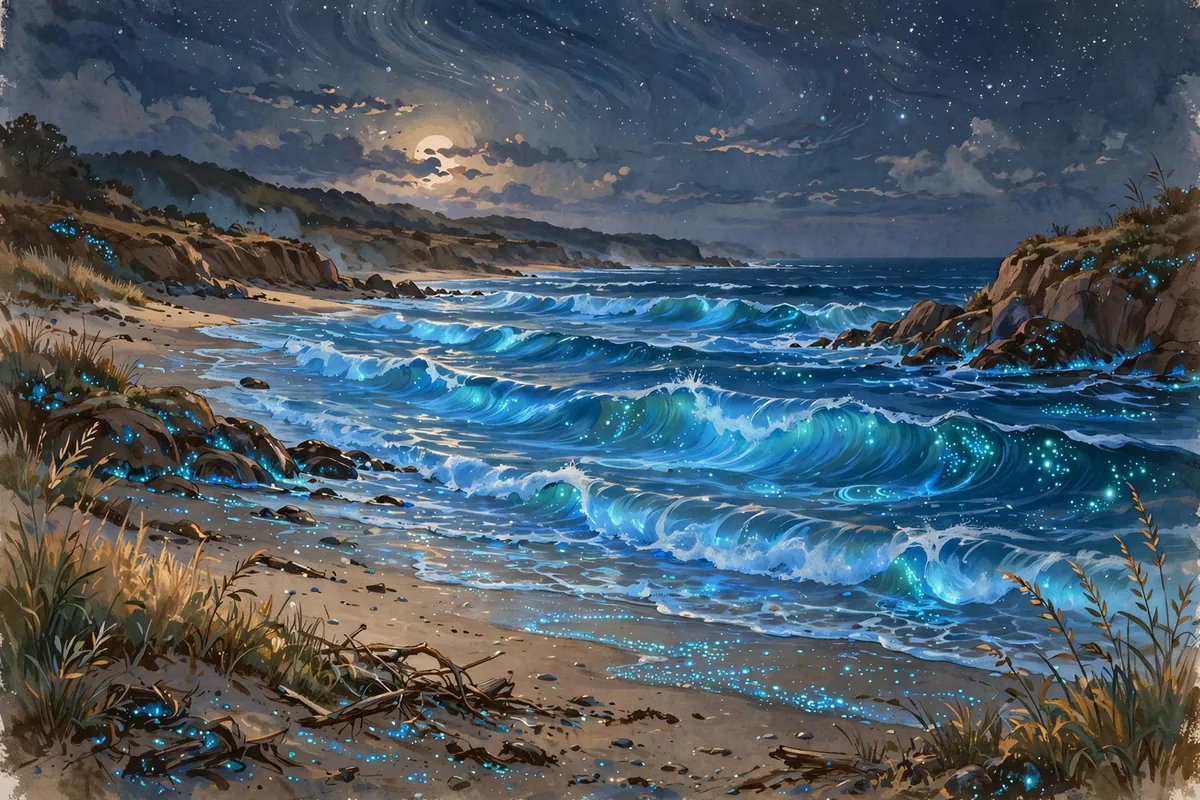
Imagine strolling along a dark beach and noticing that each wave lights up bright blue as it breaks. Kick the water and it sparkles. Swish your hand and it glows. People who see it often say it looks like magic, or like the ocean is full of stars.
It's a natural light show called bioluminescence, which means light made by living things. In the sea, the most common source is tiny single-celled plankton called dinoflagellates that live near the surface. When the water is disturbed, by a wave, a boat, or a swimmer, they give off flashes of light, which creates that sparkling glow.
How Tiny Plankton Make Light
The light comes from a chemical reaction. In most cases, a substance called luciferin reacts with an enzyme called luciferase. The reaction leaves a molecule in an energized state, and as it settles down, it releases visible light.
One well-known glowing plankton is Noctiluca scintillans, whose name comes from Latin words meaning "light at night" and "throwing out flashes of light." It's a single cell, usually less than a sixteenth of an inch across, and it drifts with the current because it can't really swim. Divers know it for the blue flashes it makes during night dives.
A Burglar Alarm in the Water
Why would plankton glow? Scientists think it's mostly about defense, though they still debate exactly how it works. Dinoflagellates light up when they sense a predator nearby.
One leading idea is called the burglar alarm hypothesis. The flash may draw the attention of bigger predators, which then go after the creature trying to eat the plankton. There's evidence for it. Tiny grazing crustaceans called copepods let flashing plankton go unharmed, likely because a glowing belly would make them easy targets.
Deep-sea predatory fish have solved that problem in their own way. Their stomachs have a black lining that hides the light from any glowing prey they swallow.
Where to See It
Glowing plankton thrive in warm-water lagoons and bays with narrow openings to the ocean. One of the most famous is Puerto Mosquito on the island of Vieques in Puerto Rico. There, a dinoflagellate called Pyrodinium bahamense glows blue whenever the water is stirred.
Puerto Mosquito is one of seven bays in the Caribbean that glow all year round. Its light depends on a special mix of conditions: the surrounding red mangrove forest, warm water, the depth of the bay, and a lagoon free of modern development. It was named a National Natural Landmark in 1980.
Pretty, but Not Always Harmless
There's a flip side. Huge blooms of Noctiluca can turn the water pink or orange in daylight, part of what's known as a red tide, and some of these blooms can harm the environment. Scientists also see them as a possible sign of pollution from human activity.
People have puzzled over glowing seas for centuries. Charles Darwin saw them on his voyages and guessed that electricity in the air was responsible. He was wrong on that one, but he can be forgiven, since the chemistry wasn't understood yet.
Today we know the truth is even better than a guess. Those glowing waves are made by countless tiny living lanterns, each one flashing a little warning in the dark. If you ever get the chance to see it, don't pass it up.