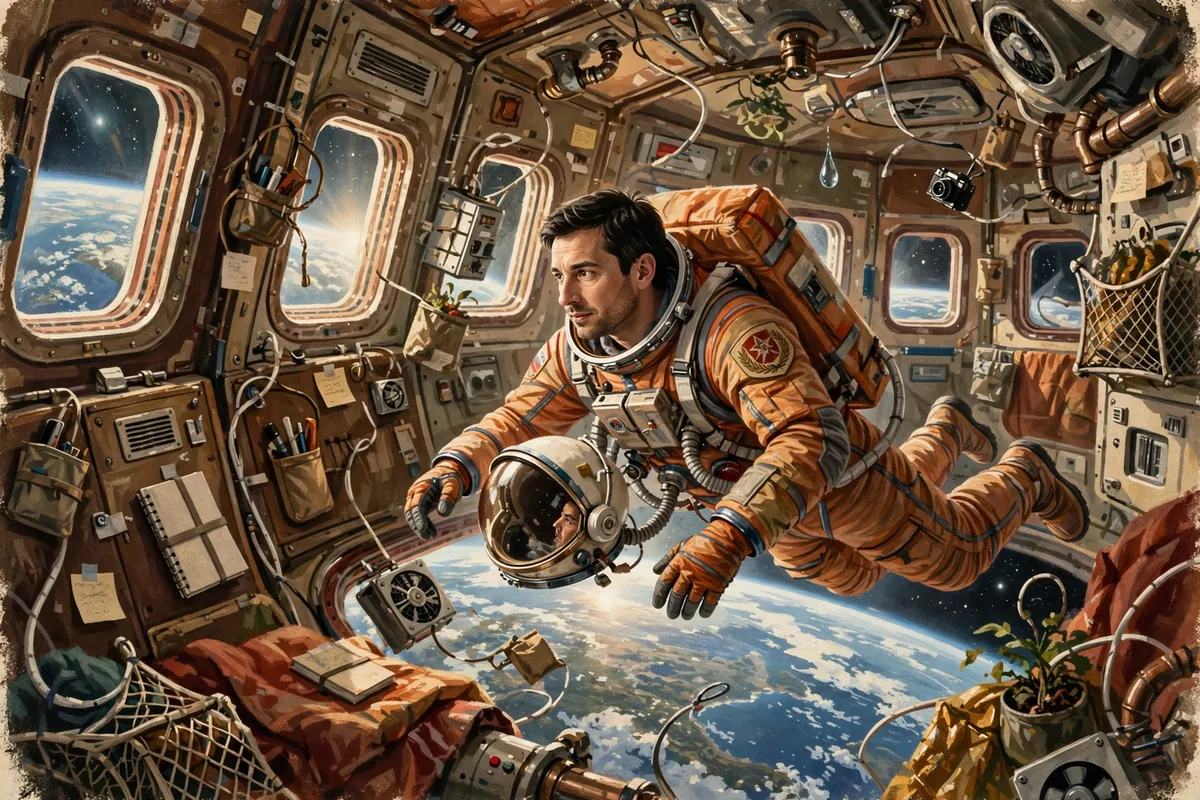
Most of us get restless after a long weekend away from home. Now imagine floating in a metal station high above Earth, with no fresh air, no rain, and no walk around the block, for well over a year. Someone actually did it, on purpose. So who has stayed in space the longest?
The short answer is Valeri Polyakov, a Soviet and Russian cosmonaut who was also a medical doctor. He spent about 437 days aboard the Mir space station on a single trip, from January 1994 to March 1995. That's more than 14 months, and it is still the record for the longest single stay in space.
A Doctor With a Mission
Polyakov didn't just end up in space by chance. He trained as a physician in Moscow and then specialized in space medicine. He decided to devote himself to the field in 1964, after Boris Yegorov became the first physician to fly in space.
He was selected as a cosmonaut in 1972 and made his first spaceflight in 1988, staying 240 days. For his second flight, he volunteered for something much longer. His goal was to learn how the human body would hold up during long missions in weightlessness, the kind of trip people might one day take to Mars.
437 Days Above the Earth
Polyakov launched on January 8, 1994, aboard Soyuz TM-18. On Mir, he conducted experiments and research and completed just over 7,000 orbits of Earth. On January 9, 1995, after 366 days in space, he officially broke the previous record, set six years earlier by Vladimir Titov and Musa Manarov.
He landed aboard Soyuz TM-20 on March 22, 1995. His official time was 437 days, 17 hours, 58 minutes, and 31 seconds. That's a full year in orbit plus more than two extra months, all without a single step on solid ground.
He Walked Instead of Being Carried
After a long stay in space, returning crew members are often carried from the capsule because their bodies need time to readjust to gravity. Polyakov had a point to make. He chose not to be carried the few feet from the Soyuz capsule to a nearby lawn chair. Instead, he walked.
He wanted to show that people could be physically able to work on the surface of Mars after a long trip to get there. Researchers have since used data from his flight to conclude that humans can keep a healthy state of mind during long missions, much as they would on Earth.
Other Space Records
Polyakov's single-trip record has stood for decades, but others have piled up more total time across several missions. Russian cosmonaut Oleg Kononenko has spent a record 1,111 days in space over five long missions on the International Space Station. He passed the previous record of 878 days, held by Gennady Padalka, in February 2024.
For Americans, the record belongs to NASA astronaut Frank Rubio, a U.S. Army flight surgeon. His mission was meant to last about six months, but damage to his spacecraft stretched it out. He returned in September 2023 after 371 days, the longest single spaceflight by an American.
Polyakov passed away in 2022 at age 80, but his record lives on. The next time you see the space station crossing the night sky, remember the doctor who spent 437 days up there, then stepped out and walked to his chair to prove a point.