"The dark side of the Moon" sounds mysterious, maybe even a little spooky. It conjures up a cold, black landscape that never sees the Sun. Plenty of people picture exactly that when they hear the phrase.
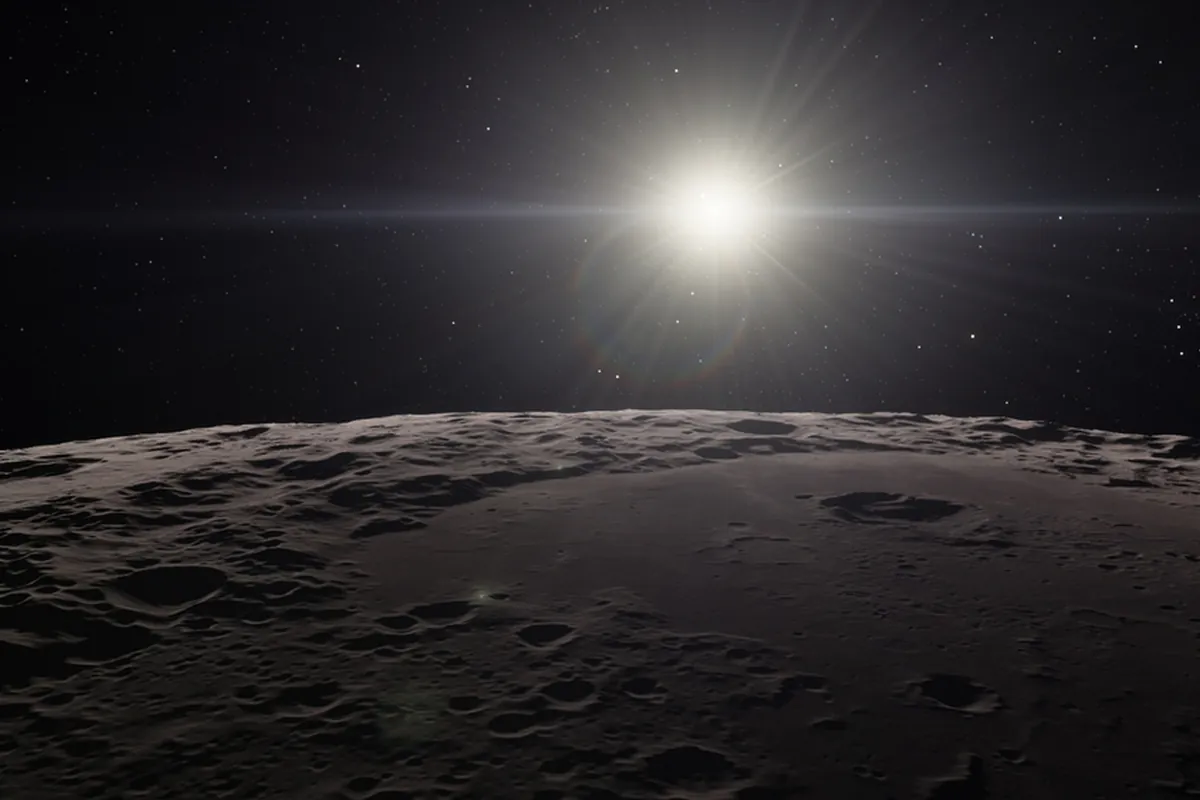
Here's the truth: the far side of the Moon isn't dark at all, at least not permanently. Every spot on the Moon gets about two weeks of sunlight followed by about two weeks of night. Over time, the near side and the far side receive almost equal amounts of sunlight. The word dark in the old phrase meant unseen, not unlit.
Why We Only See One Side
The Moon is tidally locked to Earth. That means it takes the same amount of time to spin once on its axis as it does to orbit our planet. The result is that the same face always points toward us, and the other face always points away.
Thanks to a slight wobble called libration, we can occasionally glimpse about 18 percent of the far side from Earth. But the remaining 82 percent stayed hidden from human eyes for all of history, until the space age.
In fact, when the Moon looks completely dark to us during a new moon, the far side is the part bathed in sunlight. The Sun is simply shining on the side we can't see.
The First Look
On October 7, 1959, the Soviet probe Luna 3 took the first photographs of the far side. The Soviet Academy of Sciences published the first atlas of the far side in 1960, cataloging 500 landscape features.
The first people to see it with their own eyes were the Apollo 8 astronauts, who orbited the Moon in December 1968. During Apollo missions, spacecraft behind the Moon lost direct radio contact with Earth, which made for some tense moments in Mission Control until the craft came back into view.
A Brighter, Bumpier Face
Here's a twist: the far side is actually more reflective than the near side. The side we see has large, dark plains called maria, or seas. The far side has relatively few of them.
Instead, it's rugged and packed with impact craters, looking more like Mercury than the familiar face we know. It also holds one of the largest craters in the solar system, the South Pole–Aitken basin.
Landing on the Hidden Side
For decades, every Moon landing took place on the near side. That changed on January 3, 2019, when China's Chang'e 4 made the first landing on the far side and released a rover named Yutu-2. Because the far side can't talk to Earth directly, China launched a relay satellite called Queqiao to pass messages along.
In 2024, China's Chang'e 6 mission went further. It landed on the far side and returned to Earth on June 25 with humanity's first samples from the Moon's hidden face.
Astronomers are excited about the far side for another reason. The Moon itself blocks radio noise from Earth there, which could make it a superb spot for radio telescopes someday.
A Better Name
So if you want to be precise, call it the far side of the Moon. It sees sunrises and sunsets just like the near side. It's only dark in the sense that, for most of history, nobody had ever laid eyes on it.
Next time you look up at a new moon, you can picture the other side glowing in full sunshine, quietly taking its turn in the light.