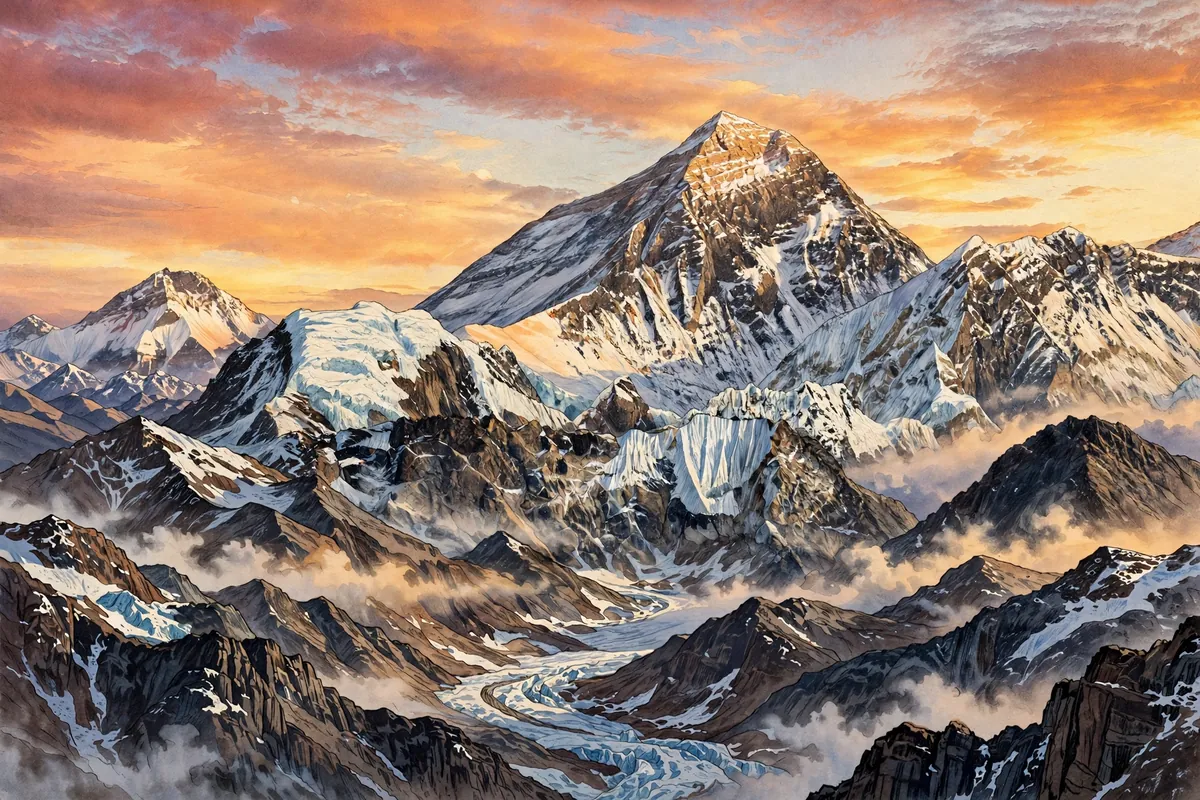
Mount Everest is the highest mountain on Earth above sea level. Its most recent official height, measured in a joint 2020 survey by Nepal and China, is 29,031 feet and change. You'd think a number like that would be set in stone. But the mountain itself has other plans.
Everest is still growing. The Indian and Eurasian tectonic plates are pressing together beneath the Himalayas, and that ongoing collision is slowly pushing the mountain higher. Estimates vary, but one puts the rise at about 2 millimeters a year and another at about 4 millimeters. That's well under a quarter inch annually, slow but steady.
A Slow-Motion Crash
To understand why, you have to go back millions of years. The land that is now India drifted north and collided with Asia. That collision folded, crumpled, and stacked layers of rock on top of each other, building the Himalayas.
The collision isn't over. The boundary where the Indian Plate meets the Eurasian Plate runs along a huge fault system called the Main Himalayan Thrust. Scientists think the movement along these faults is still adding to Everest's height and nudging its summit toward the northeast, by roughly 3 to 6 millimeters a year sideways, according to some accounts.
Not every measurement agrees. One account suggests much more sideways movement, and some researchers have even suggested the mountain could shrink at times. Measuring a moving mountain is tricky. After the major earthquake in Nepal in April 2015, Nepal planned a new survey partly to check whether the quake had changed Everest's height.
Sea Fossils at the Top of the World
Here's one of the most astonishing facts about Everest: its summit rock was once at the bottom of the sea. The upper layers of the mountain are made of marine sediments that built up along the coast of ancient India before it ran into Asia.
The collision then lifted those layers skyward. Today, the highest rocks on the planet are fossil-bearing marine limestone. In 2022, the International Union of Geological Sciences named these rocks of Mount Everest one of its 100 geological heritage sites around the world.
Deeper inside the mountain, the story is just as dramatic. Some of Everest's rocks were pushed down during the collision to depths of more than 9 to 12 miles below sea level, where they were heated and partly melted. Then they were forced back up toward the surface.
Tallest, but Not Farthest Out
Everest holds the title of highest mountain above sea level. But there's a fun twist. Because Earth bulges at the equator, the summit of Chimborazo in Ecuador is actually about 7,100 feet farther from Earth's center than Everest's summit, even though Chimborazo is only about 20,560 feet above sea level.
And most Everest climbers don't climb anything close to the full height. They usually start from base camps above 16,000 feet. To climb the whole thing from sea level, you'd need to start at the Bay of Bengal, about 430 miles away. One team actually did that in 1990.
Even from base camp, the climb is no small thing. The standard route isn't especially technical, but altitude sickness, harsh weather, wind, avalanches, and the treacherous Khumbu Icefall make it dangerous. As of May 2024, 340 people had died on the mountain.
So the next time you see a picture of Everest, remember it's not a finished monument. It's a work in progress, still being lifted, bit by bit, by two continents that haven't stopped pushing.