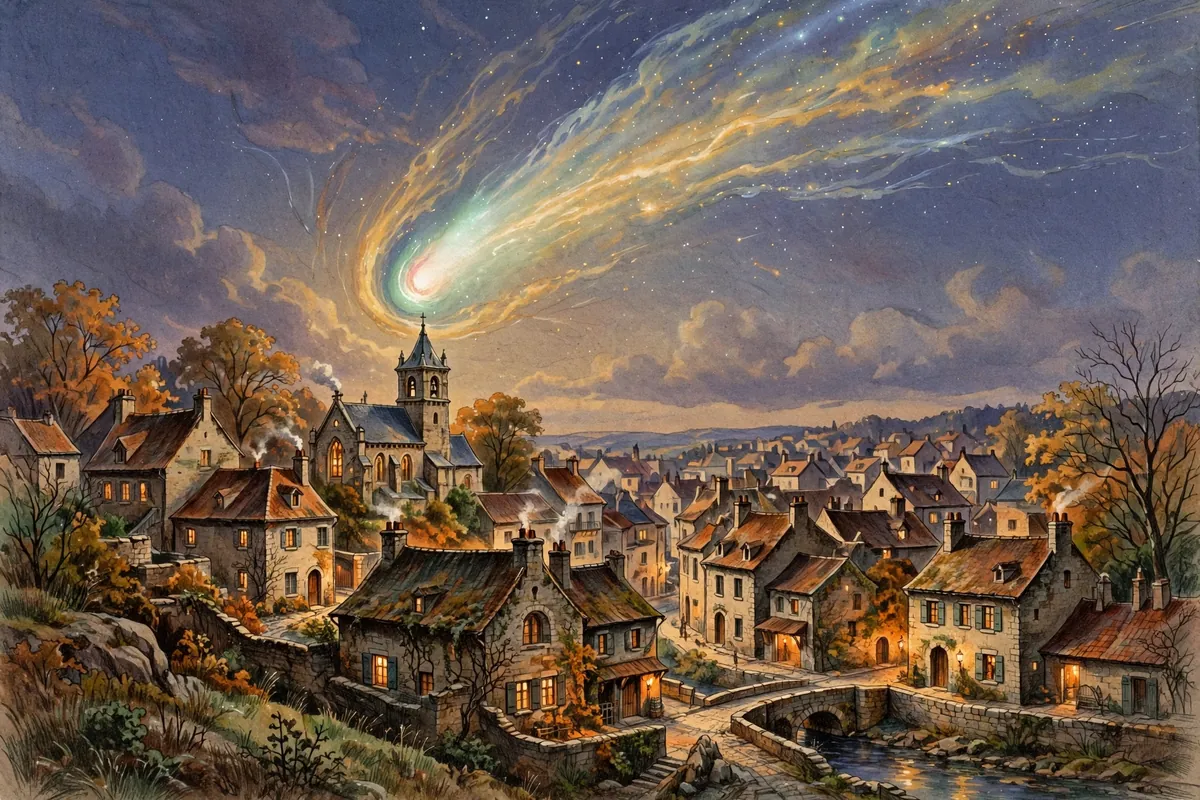
Some sky events happen every night. Others come along once a year. And then there's Halley's Comet, which shows up so rarely that most people get only one chance to see it. If you caught it in 1986, you're part of a fairly exclusive club.
Here's the short answer. Halley's Comet is the only known short-period comet that can regularly be seen with the naked eye from Earth. It returns roughly every 74 to 79 years, which is why it's often called the 76-year comet. It last swung through the inner solar system in 1986, and it's due back in 2061.
The Man Who Made the Prediction
People had been recording the comet's visits since at least 240 BC, but nobody realized it was the same object coming back. For centuries, many thought comets were disturbances in the air or that they traveled in straight lines.
That changed with Edmond Halley, an English astronomer and friend of Isaac Newton. In 1705, using Newton's new laws of gravity, Halley studied old records and noticed that comets seen in 1531, 1607, and 1682 had nearly identical paths. He concluded they were one comet returning about every 76 years, and predicted it would be back in 1758.
Halley died in 1742, before he could see if he was right. On Christmas Day 1758, a German farmer and amateur astronomer spotted it. The prediction had come true, and the comet was named in Halley's honor.
Famous Appearances Through History
In 1066, the comet blazed over England and was seen as an omen. Later that year, King Harold II died at the Battle of Hastings, and William the Conqueror took the throne. The comet even appears in the famous embroidered cloth from Bayeux, France, that tells the story of the Norman Conquest.
In 1301, the Italian painter Giotto saw it and is thought to have used it as the Star of Bethlehem in his Nativity scene, painted as a fiery comet.
Mark Twain was born in 1835, just two weeks after the comet's closest pass by the Sun. In his autobiography, he wrote that he came in with Halley's Comet and expected to go out with it. He died on April 21, 1910, the day after its closest approach to the Sun on its next visit.
Comet Panic of 1910
The 1910 visit was the first time the comet was photographed. Scientists studying its tail found a toxic gas called cyanogen, and Earth was set to pass through the tail on May 19.
Newspapers speculated that life on Earth might be in danger. Scientists said there was nothing to fear, but some people bought gas masks anyway, and con artists sold so-called anti-comet pills. Earth passed through the tail just fine.
Up Close in 1986, and Next Time
In 1986, a fleet of spacecraft nicknamed the Halley Armada flew out to meet the comet. Europe's Giotto probe made the closest pass and helped confirm that the comet is a dirty snowball of ice and dust. Its solid core turned out to be surprisingly small, only about 9 miles long.
The comet will next reach its closest point to the Sun on July 28, 2061. This time it will be on the same side of the Sun as Earth, so it should put on a better show than in 1986. Mark your calendar, or tell the grandkids. For many of us, it's a once-in-a-lifetime visitor worth waiting for.