Ask most people what the appendix does and you'll probably hear a shrug, or a joke. For a long time it was the poster child for useless body parts, a little pouch that seemed to exist mainly to get inflamed and send people to the hospital.
The short answer: scientists now think the appendix isn't useless after all. It's surrounded by immune tissue, and a leading idea is that it serves as a safe house for helpful gut bacteria, helping the gut restock them after an illness like a bad bout of diarrhea. Researchers are still working out the details, but the old "useless" label is fading.
A Worm-Shaped Mystery
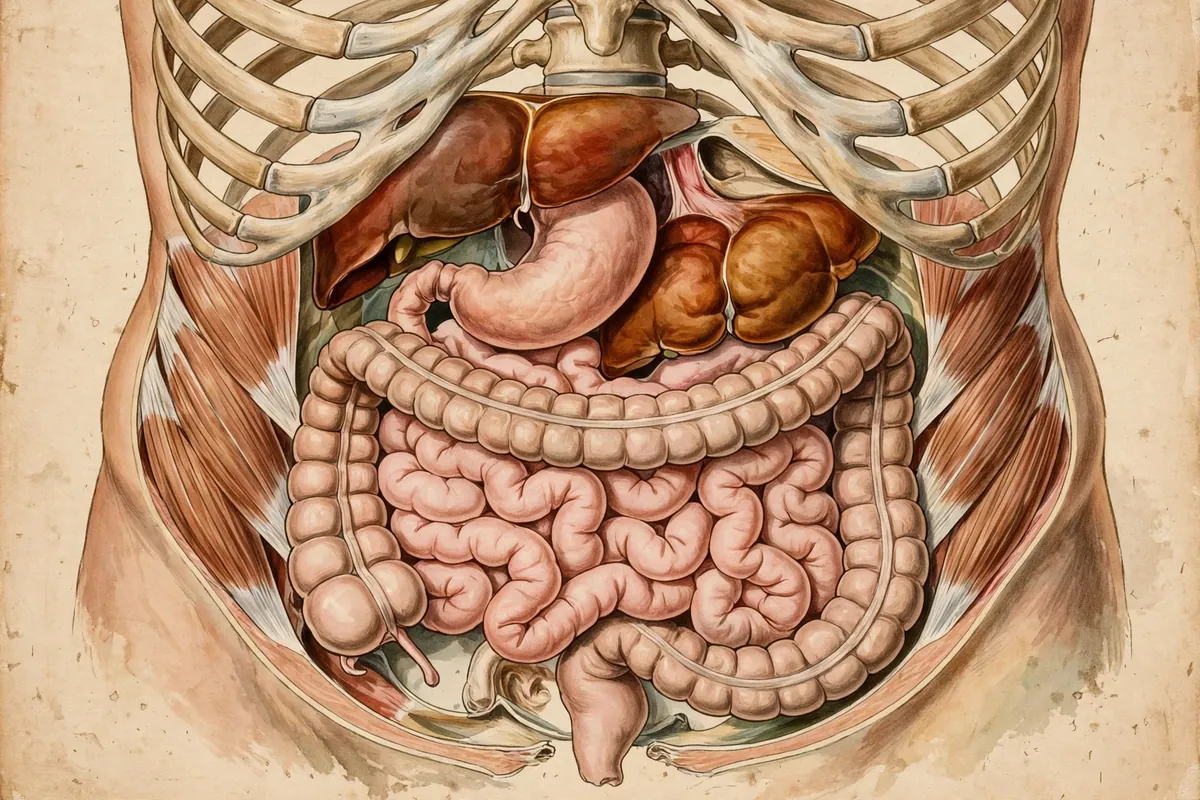
The appendix is a finger-like tube with a closed end, attached to the cecum, a pouch at the spot where the small intestine meets the large intestine. It usually sits in the lower right part of the belly, near the right hip bone.
Its formal name is the vermiform appendix. Vermiform comes from Latin and means worm-shaped, which is a pretty fair description.
For years, doctors noticed that people seemed fine after having it removed. Because there were no obvious side effects, the appendix was assumed to have no specific job.
Darwin's Old Explanation
Charles Darwin had a theory. He suggested that our distant ancestors used the appendix to help digest tough, fibrous plants. Some plant-eating animals, such as horses, rodents, and koalas, have a large cecum that helps host bacteria that break down plant material.
In that view, the human appendix was a shrunken leftover from a leafier diet. It was a tidy story, and it stuck around for a long time.
What Newer Research Suggests
Since the early 2000s, researchers have taken a much closer look. The appendix turns out to be part of the body's immune system in the gut. It's linked to immune cells that help recognize and fight viruses and bacteria in that part of the bowel.
The most talked-about idea is the safe-house theory. During a gut infection, beneficial bacteria can get flushed out. Scientists think the appendix may hold a reserve of these helpful microbes, so the gut can recover afterward. That would have been especially valuable in places without modern medicine or clean water, where diarrhea was a common killer.
The Clue From Other Animals
One of the strongest hints comes from comparing species. A 2013 study estimated that an appendix evolved separately in different animals 32 to 38 times, but was lost no more than six times. A 2017 study found similar results.
If a body part keeps showing up again and again across the animal world and rarely disappears, that suggests it gives some advantage. A 2023 study even reported that the appendix helped protect young primates against diarrhea. Not every scientist is fully convinced, and the debate over whether it's vestigial continues, but the evidence has shifted.
Still Worth Respecting
None of this changes the fact that appendicitis is serious. When the appendix becomes inflamed, it commonly causes pain in the lower right belly, along with nausea, vomiting, or fever, though about 40 percent of people don't have those typical symptoms. The standard treatment is surgery to remove it. If you ever have sudden, worsening belly pain, get medical help right away and talk to your doctor.
So the appendix may be less of a leftover and more of a quiet backup plan. It's a nice reminder that just because we haven't figured out what something does doesn't mean it does nothing.