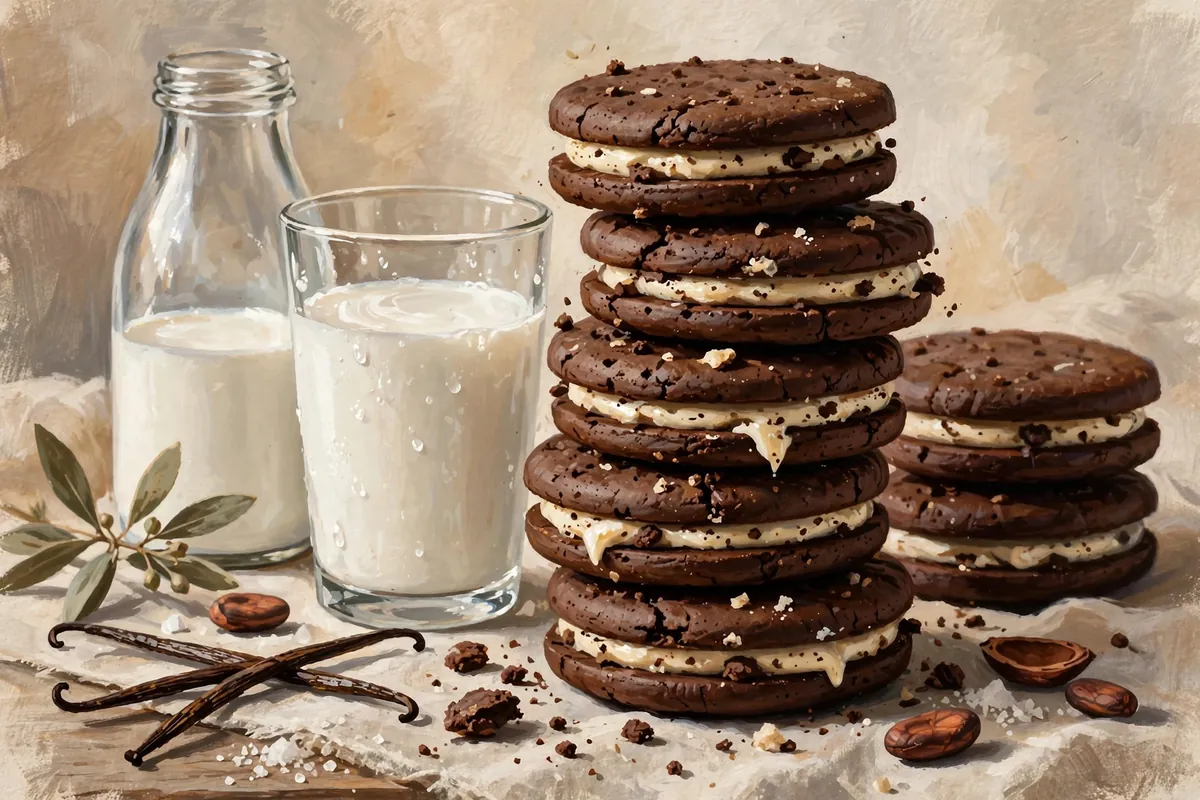
Few snacks feel as timeless as the Oreo. Two dark chocolate cookies, a sweet white filling, and a glass of milk on the side. It's easy to imagine that the cookie in your pantry is exactly what shoppers bought more than a century ago.
That's only partly true. The Oreo was introduced in 1912, and the basic idea of two cocoa cookies with a creamy filling has stuck. But the cookie's name, the design stamped on its face, and the recipe for its filling have all changed over the years. The Oreo you eat today is a modern update of a very old favorite.
How It Started
The National Biscuit Company, now Nabisco, first made the Oreo Biscuit in early 1912 at its factory in the Chelsea neighborhood of New York City. That building is part of today's Chelsea Market, and in 2002 that block of Ninth Avenue was ceremonially named Oreo Way.
The name Oreo was trademarked on March 14, 1912. The first Oreos were sold on March 6 of that year to a grocer in Hoboken, New Jersey. They were sold by the pound, at 25 cents, in metal canisters with glass tops. Nobody knows for sure where the name came from. One theory points to the French word or, meaning gold, since the original tin was gold-colored. Another links it to a Greek word for mountain, because the cookie was first imagined as dome-shaped.
Here's a surprise. The Oreo was actually an imitation of an earlier cookie, Hydrox, introduced in 1908. The Oreo became so much more popular that many people now assume Hydrox is the copycat.
A Cookie With Many Names and Faces
The Oreo Biscuit became the Oreo Sandwich in 1921, the Oreo Crème Sandwich in 1948, and finally the Oreo Chocolate Sandwich Cookie in 1974. That last name has stuck ever since.
The look changed too. The original stamp had a wreath around the edge and the name in the center. A new design arrived in 1924, and the modern pattern was created in 1952 by William A. Turnier, adding the Nabisco logo.
What's Inside Changed Too
The filling has seen the biggest changes. The modern filling was developed by Nabisco's principal food scientist, Sam Porcello, who held five patents related to his work on the Oreo.
Originally, the creamy center contained lard. In the early 1990s, health concerns led Nabisco to replace it with partially hydrogenated vegetable oil, which also allowed the cookies to become kosher-certified. Then in 2006, the company removed trans fat and switched to non-hydrogenated vegetable oil.
Flavors have come and gone. A lemon-filled Oreo appeared in 1920 but was dropped in 1924, leaving the original as the only version for decades. Double Stuf, with about twice the filling, arrived in 1974, and many more varieties have followed.
Still Hugely Popular
Whatever has changed, people clearly still love it. By 2012, an estimated 450 billion Oreos had been sold since 1912. By 2017, more than 40 billion were being made every year in 18 countries. Oreo has been the world's best-selling cookie brand since 2014.
So the Oreo hasn't stood perfectly still since 1912. It has quietly kept up with the times while keeping the look and taste people expect. That may be the real secret to staying a favorite for more than a hundred years.