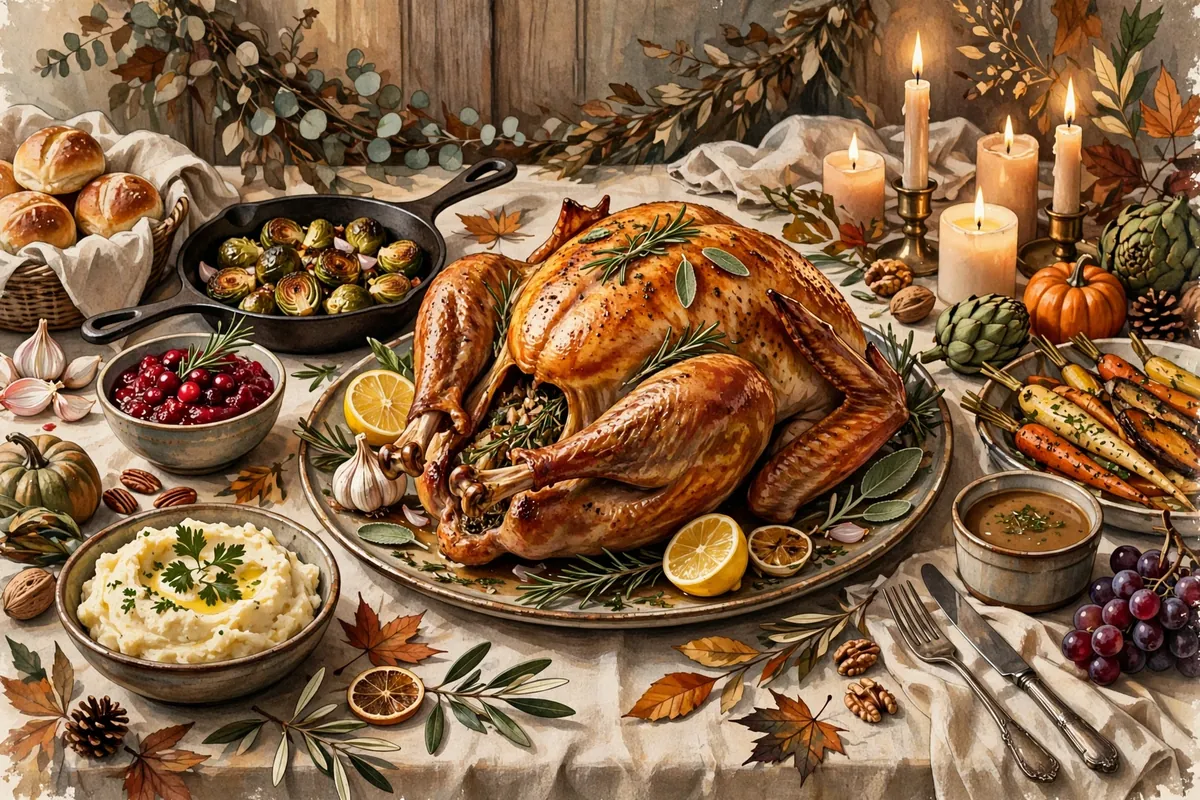
For millions of American families, it isn't Thanksgiving without a golden turkey on the table. Some people even call it Turkey Day. But how did one big bird become the star of a national holiday? The answer is a mix of history, convenience, and some very persuasive magazine writing.
Here's the short version. Wild turkeys were plentiful in early America, and the Pilgrims mentioned them around their 1621 harvest. But the modern turkey-centered Thanksgiving really took shape in the 1800s, built on New England harvest traditions and promoted by a magazine editor named Sarah Josepha Hale, whose campaign helped make Thanksgiving a national holiday.
What the Pilgrims Actually Ate
Two colonists wrote about the 1621 feast at Plymouth. Edward Winslow said the governor sent four men out "fowling," and they brought back enough birds to feed the group for almost a week. The Wampanoag leader Massasoit came with about ninety men, and they went out and killed five deer for the celebration.
William Bradford wrote that besides waterfowl, there was "a great store of wild turkeys." So turkey may well have been on the menu. But historians point out that the local diet also included fish, eels, shellfish, and a Wampanoag cornmeal dish called nasaump. There were no potatoes, and no pies, since the colonists had no butter, wheat flour, or sugar.
A Bird That Was Always Around
Turkeys were once so abundant in the wild that people ate them all year, and they were considered a common food. Oddly enough, before the 20th century, pork ribs were often the more special holiday food in North America, since hogs were usually slaughtered in November.
By the 1800s, New England Thanksgivings had their own customs. A traditional celebration might include a raffle where the prizes were mostly geese or turkeys, church services, and a big feast with turkey and pumpkin pie, alongside dishes most of us have never tried, like pigeon pie.
The Woman Who Built the Holiday
Sarah Josepha Hale, a New Hampshire native, edited Godey's Lady's Book, the most widely read magazine in the country before the Civil War. She was the chief promoter of the modern Thanksgiving, shaping everything from the foods served to the decorations. Every November, she wrote about the holiday in her column.
Her editorials helped convince President Abraham Lincoln to begin the regular practice of proclaiming a national Thanksgiving during the Civil War. Around the same time, the 1621 feast got a new nickname. In an 1841 reprint of an old Pilgrim account, an editor named Alexander Young became the first to call it the "first Thanksgiving."
Turkey Today
The tradition stuck. About 40 million turkeys were eaten on Thanksgiving Day alone in 2019. Today's typical spread of turkey, stuffing, cranberry sauce, mashed potatoes, and pumpkin pie grew out of New England harvest foods, with regional favorites like pecan pie and macaroni and cheese joining over time.
Even the White House turkey pardon has a fuzzy backstory. Legends credit Lincoln or Harry Truman, but there's no evidence for either in the presidential record. George H. W. Bush made it a permanent yearly tradition.
So when you carve the turkey this year, you're honoring a bird that was always plentiful, a feast that grew over centuries, and one determined editor who wanted the whole country to sit down together.