Ask a child to draw a carrot and you'll get a bright orange triangle with a green tuft on top. It's one of the most recognizable vegetables in the world. But if you could time-travel to a market in Persia a thousand years ago, the carrots for sale might look strangely different.
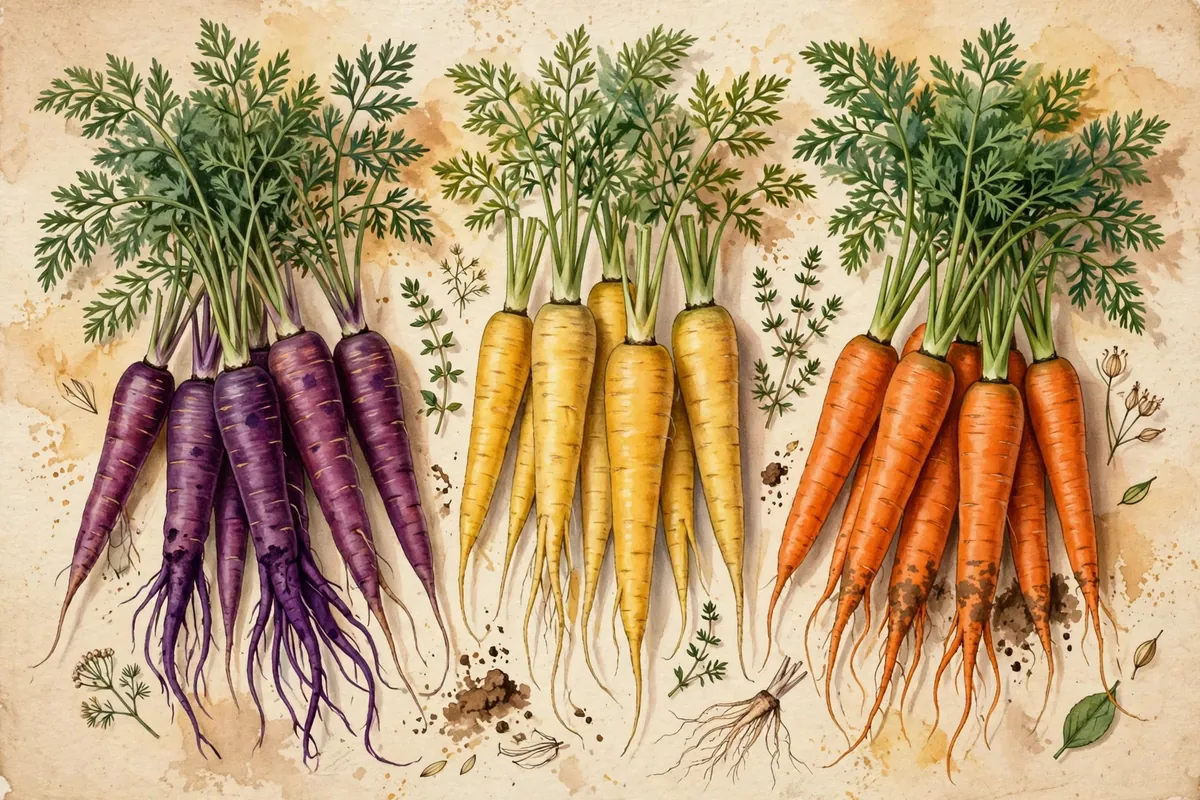
Here's the short answer. Early domesticated carrots in West Asia were mostly purple or yellow. Their purple color comes from natural pigments called anthocyanins, the same family of pigments found in many dark fruits. The orange carrot we know today became a stable variety thanks to Dutch growers, who developed a type called Long Orange around the start of the 1700s.
Where Carrots Came From
The carrot is a domesticated form of the wild carrot, which is native to Europe and Southwestern Asia. Studies suggest the domestic carrot has a single origin in Central Asia, and the plant was probably first grown in Iran, where people cultivated it for its leaves and seeds.
Over centuries, farmers bred wild carrots to be less bitter, sweeter, and less woody. By the 10th century, carrot roots from West Asia, India, and Europe were purple. Writers in the 11th and 12th centuries described red and yellow carrots too. These older types, often called Eastern carrots, still survive today. They're usually purple or yellow, and often have branched roots.
Old books offer colorful clues. A 6th-century copy of a famous Greek guide to medicinal plants describes the carrot and notes that the root can be cooked and eaten. Another copy made not long afterward shows the very same roots painted purple.
Enter the Orange Carrot
The orange carrot, sometimes called the Western carrot, emerged in the Netherlands in the 16th or 17th century. There's pictorial evidence that orange carrots existed much earlier, but they probably weren't a stable variety until Dutch growers bred Long Orange in the early 1700s.
That bright color comes from beta-carotene, which the body can turn into vitamin A. It's the reason carrots earned their healthy reputation.
The Prince of Orange Legend
You may have heard that Dutch farmers bred orange carrots to honor William of Orange and the Dutch royal house. It's a wonderful story. Unfortunately, there's little evidence for it beyond oral tradition and the timing.
Some experts suggest a more practical reason orange won out. Purple carrots tend to turn soups and stews brown, while orange ones don't. In other words, the orange carrot may have simply looked better in the pot.
Another Carrot Myth: Seeing in the Dark
During World War II, a rumor spread that British pilots shot down enemy planes at night because they ate lots of carrots. The real secret was a new technology called radar.
Britain still encouraged everyone to eat carrots as part of its Dig for Victory campaign. A radio program suggested creative recipes, including carrot jam. The public bought into the night-vision idea so much that by 1942 Britain had a 100,000-ton carrot surplus.
In truth, beta-carotene from carrots doesn't help people see in the dark unless they're lacking vitamin A. If you're worried about your eyesight, talk to your doctor.
Today, purple, yellow, red, and even white carrots are making a comeback in farmers markets as heirloom varieties. So the next time you spot a bunch of purple carrots, you're not looking at a newfangled novelty. You're looking at the carrot's original colors.